Four Difficult GCSE Maths Questions and How to Solve Them
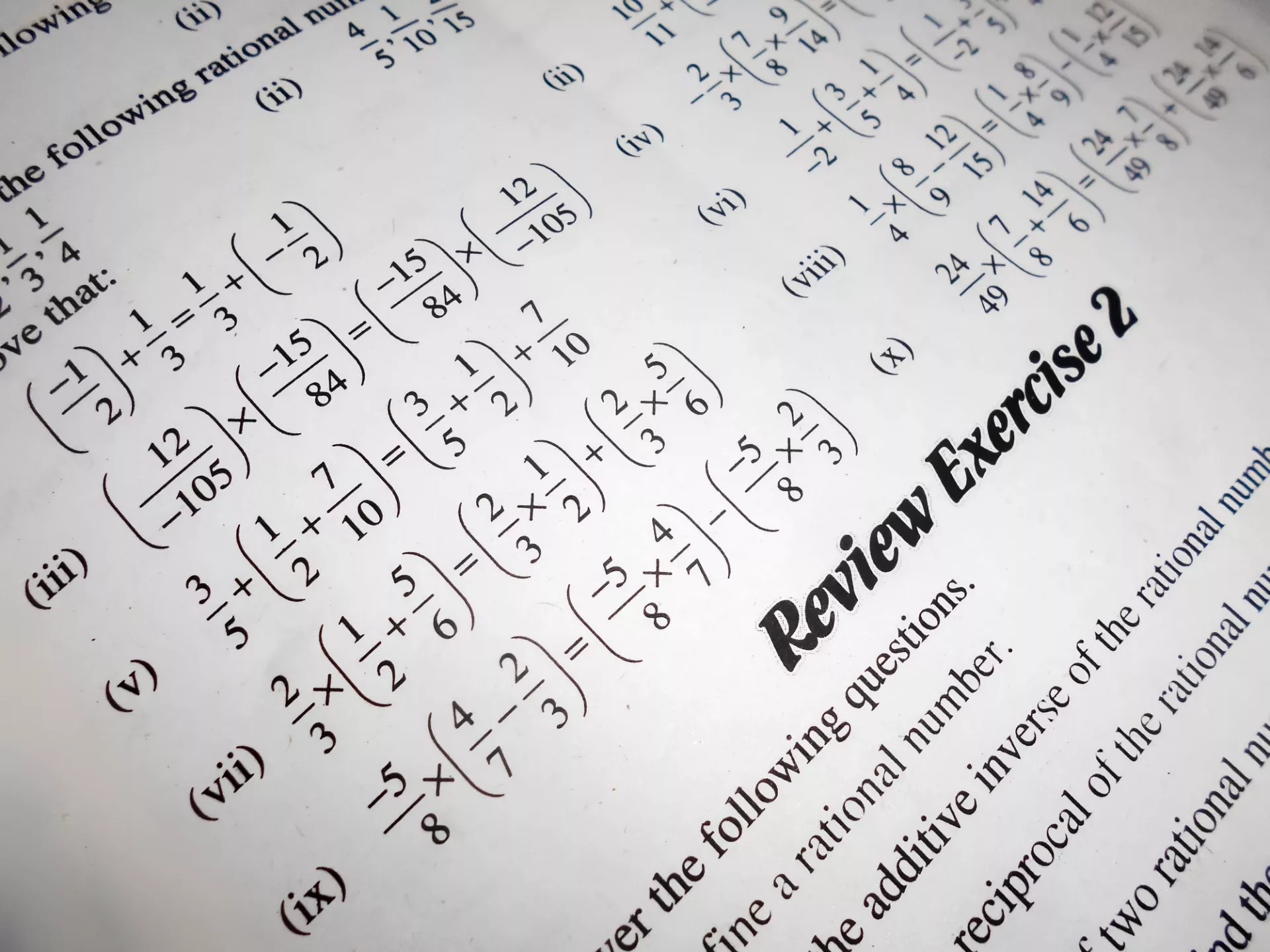
Getting through the GCSE maths course requires working on as many practice questions and solutions as possible and learning the different methods for solving problems and equations. The old saying 'practice makes perfect' applies as much to GCSE maths as to everything else. Below are four challenging worked examples covering bounds, algebraic rearrangement, vectors and geometry/trigonometry.
Complete Questions for Practice
1. Bounds and density: Jackson is trying to figure out the density of a woodblock in the shape of a cuboid, deducted in g/cm³. The length is 13.2 cm, width 16.0 cm, height 21.7 cm, and mass 1970 g, all correct to the nearest given precision. The solution works out the upper and lower bounds of each dimension, calculates the upper and lower bound volumes, then combines mass and volume bounds correctly (upper density bound uses upper mass over lower volume, and vice versa) to reach a density of 0.43 g/cm³ to two significant figures.
2. Algebraic rearrangement: Given the formula p = n² + an + a, rearranging to make (a) the subject involves cross multiplication, expansion, collecting the (a) terms on one side, factorising out (a), and dividing through to isolate it.
3. Vectors: Given a quadrilateral CDEF with CD = a, DE = b and FC = a − b, part (a) asks for FE in terms of a and b, found by tracing the path from F to E and simplifying to 2a. Part (b) introduces M as the midpoint of DE and a point X on FM such that FX:XM = n:1, solved by expressing CE, FM, FX and CX in terms of a and b, then equating and solving to find n = 4.
4. Circles in a rectangle: A rectangle contains three identical circles, each touching the others and the sides of the rectangle, with radius 24 mm. The width of the rectangle is found by summing four radii (96 mm). The length requires constructing an equilateral triangle between the three circle centres, using Sin(60°) to find its height, then adding the remaining two radii to reach a length of approximately 89.6 mm. Multiplying width by length gives an area of approximately 8600 mm² to three significant figures.
The Challenges of GCSE Maths
GCSE exams are tough – students are expected to learn multiple skills including trigonometry, geometry and algebra, and apply them correctly when problem solving. The availability of practice materials and the language used in questions are both critical to success.
What Is the Hardest Topic in GCSE Level Maths?
The most arduous topic depends on students' individual strengths and weaknesses, but when asked, many students identify geometry as the most difficult topic.
Final Thoughts
Most maths students develop a favourite topic, often dependent on having a teacher that sparks curiosity. Study hard, prepare well, make time for rest and relaxation, and take the exam with confidence.
Tell us about your child
Tell us a little about your child and what you're looking for from tutoring. We'll then consider which of our tutors we think will suit them best, starting with a free taster session.